Piglets at Dutch farm reach 400 grams of feed intake in the farrowing unit
“Feed intake during farrowing determines the success of the entire production cycle.” That is the firm belief of pig farmer Bart Jaspers, who closely monitors the feed intake of his piglets. Combined with a sharp eye for his animals, this approach results in impressive technical performance: 38 weaned piglets per sow per year, up to 400 grams of feed intake per piglet in the farrowing unit, and more than 1,000 grams of daily gain in his finishing pigs.
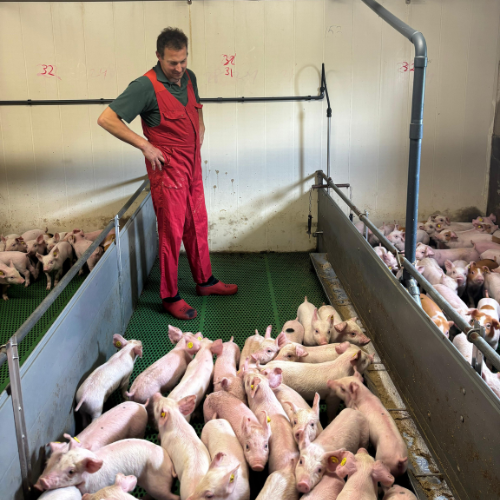
Structured management is visible from the moment you enter the farm. Hygiene protocols are followed precisely and the bar is set high at Jaspers’ nearly closed production system. Together with his brother, Jan Willem, he operates two locations. Bart manages around 900 sows with corresponding piglet and finisher units. Supported by a team of twelve employees, he also grows part of his own cereals, which he processes into feed. All finishers and half of the piglets receive liquid feed; the other half is fed dry feed due to distance from the feed kitchen. The red markings on the piglets reveal that Bart uses Tempo TN 70 x Duroc genetics. “With longer tails becoming the norm, I started introducing the calmer Duroc line. So far, I don’t see differences in farrowing results or piglet quality compared to our other farm using only Tempo,” Bart notes.
Bart Jaspers – Alphen, The Netherlands
- 900 sows with piglet and finishing units
- Tempo TN 70 x Duroc
- 38 weaned piglets per sow per year
- Weekly benchmarking with peer groups
This year, Bart achieved 38 weaned piglets per sow, an average daily gain of 1,080 grams in his finishers, and a feed conversion of 2.3. “The beauty of pig production is that every week gives you a new chance to improve,” says Bart, who is part of two study groups. Every week he receives detailed performance reports—from farrowing results and mortality to weaning-to-estrus intervals—which he uses for tight management steering.
“To manage performance weekly, I need a stable feed advisor,” Bart explains. He found that in Eddy van Herck, Earlyfeed expert at Nuscience. “Eddy is very knowledgeable, calm, and a great sparring partner.” Four years ago Bart struggled with tail biting, uneven litters, E. coli problems, and poor starts after weaning. That was the moment he switched to the Earlyfeed piglet feeding program. Eddy has been his main contact ever since, supported by liquid feeding specialist Jan van Gisbergen. “Both bring structured, well-supported advice. Our staff values them highly,” Bart says. Today, piglet performance in the farrowing unit is fully back on track.
Supplementary feeding from day three
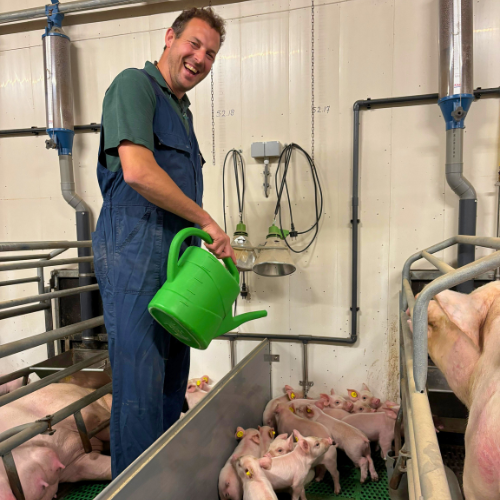
Farrowings take place on Mondays and Tuesdays, using both milk cups and fostering systems where three litters are raised by two sows. From Friday onwards, Bart starts providing Babimel Wean in small trays near the sow to stimulate feed intake through imitation behavior. “Piglets won’t naturally search for feed at this age. But Babimel Wean is very sweet and contains 20% skimmed milk powder—almost like candy for piglets—helping them learn to eat,” explains Eddy, who specializes in early-life nutrition.
The goal is for each piglet to consume at least 25 grams. After four days, Babistar Flex is added to the trays, gradually replacing Babimel Wean. Bart continues feeding Babistar Flex in combination with liquid or weaning feed until three days post-weaning. “Babistar Flex helps me maintain feed intake so piglets continue growing immediately after weaning,” he says.
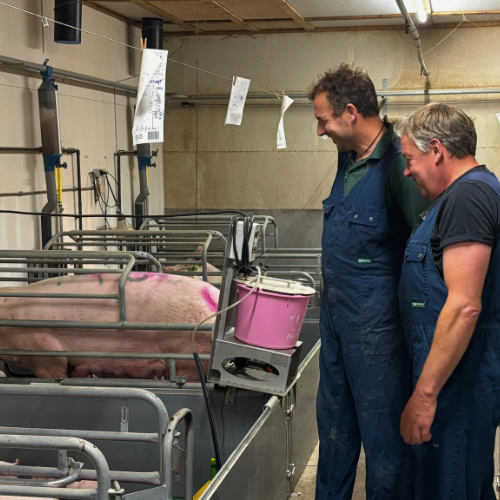
Bart closely tracks intake in the farrowing unit using simple volume measurements. “We see feed intakes ranging from 180 to 400 grams per piglet per day. And when intake in the farrowing unit is strong, the rest of the production cycle runs smoothly,” Bart concludes. Eddy adds that this success is also the result of Bart’s disciplined management: “His entrepreneurship, attention to detail, and continuous monitoring of what the animals tell him are key.”
On the way to 40 weaned piglets per sow per year
What does Bart consider essential for the best-performing piglets? High feed intake in the farrowing unit and close monitoring of what piglets actually consume. Birth quality also plays a crucial role. “Early in gestation, I steer with nutrition to achieve uniform fetal development,” he explains.
Strict hygiene is another cornerstone of his approach. “Even if you don’t see the effect immediately, it pays off with strong feed efficiency and good working conditions,” Bart says. Eddy summarizes it well: “With hygiene standards this high, it’s as if you get a few extra piglets each year.”
Finally, Bart emphasizes the importance of fresh feed: “The silo must be empty before new feed arrives.” His advice to fellow pig producers? “Watch your animals closely—they show you how things are going. And make sure you know exactly what happens with feed intake in the farrowing unit so you can manage proactively.”
With that mindset, Bart is confidently working toward his next goal: 40 weaned piglets per sow per year.
This contact was suggested based on the location you are browsing from. You can of course also consult our other contacts and locations here.